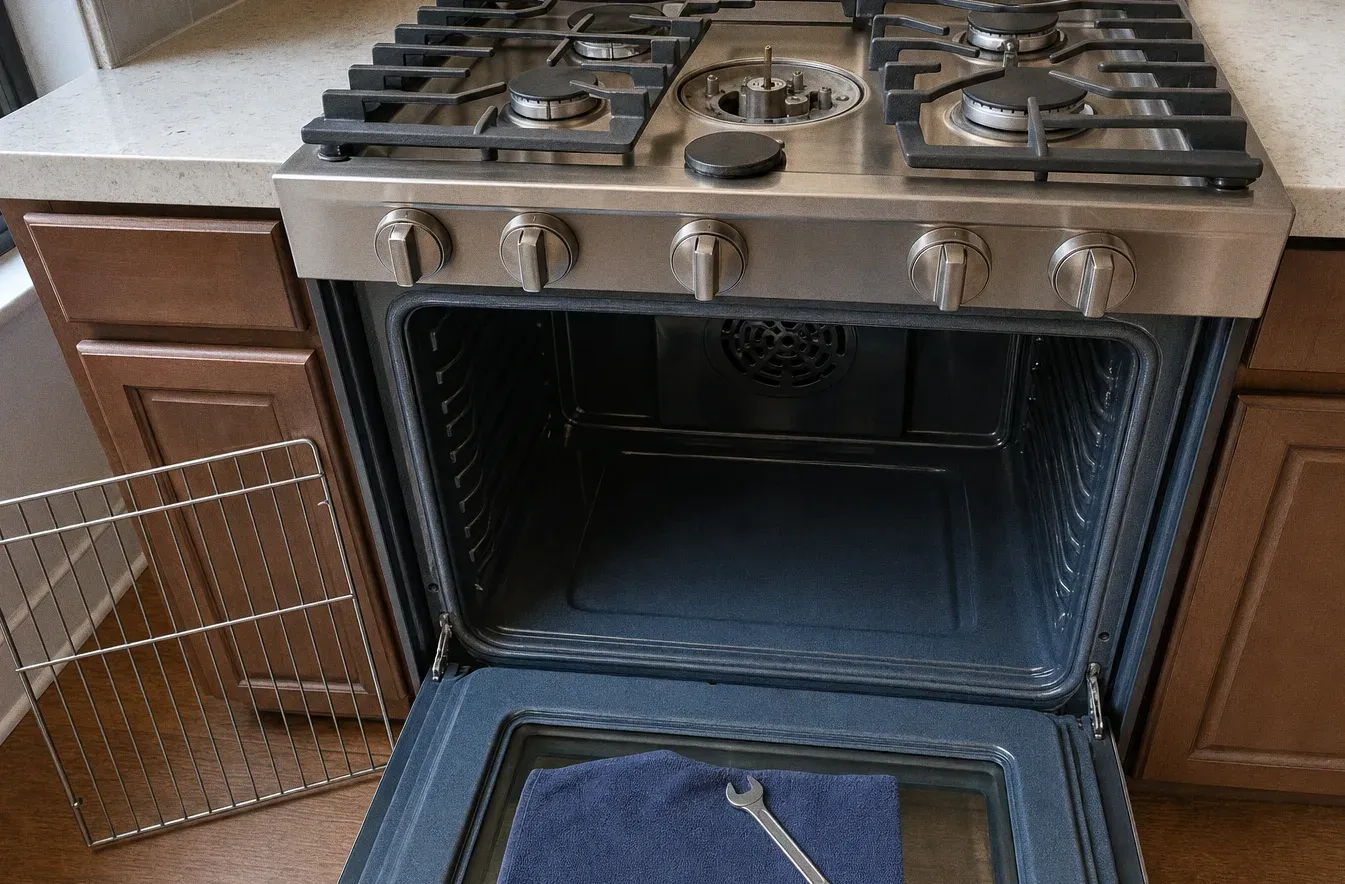
Wolf Oven Roast Setting: What It Does and How to Use It
The Roast setting on a Wolf oven heats with both the bake and broil elements and no fan, giving steady heat with a browned top; use it at 325–350°F for large or tough cuts and switch to Convection Roast for poultry.
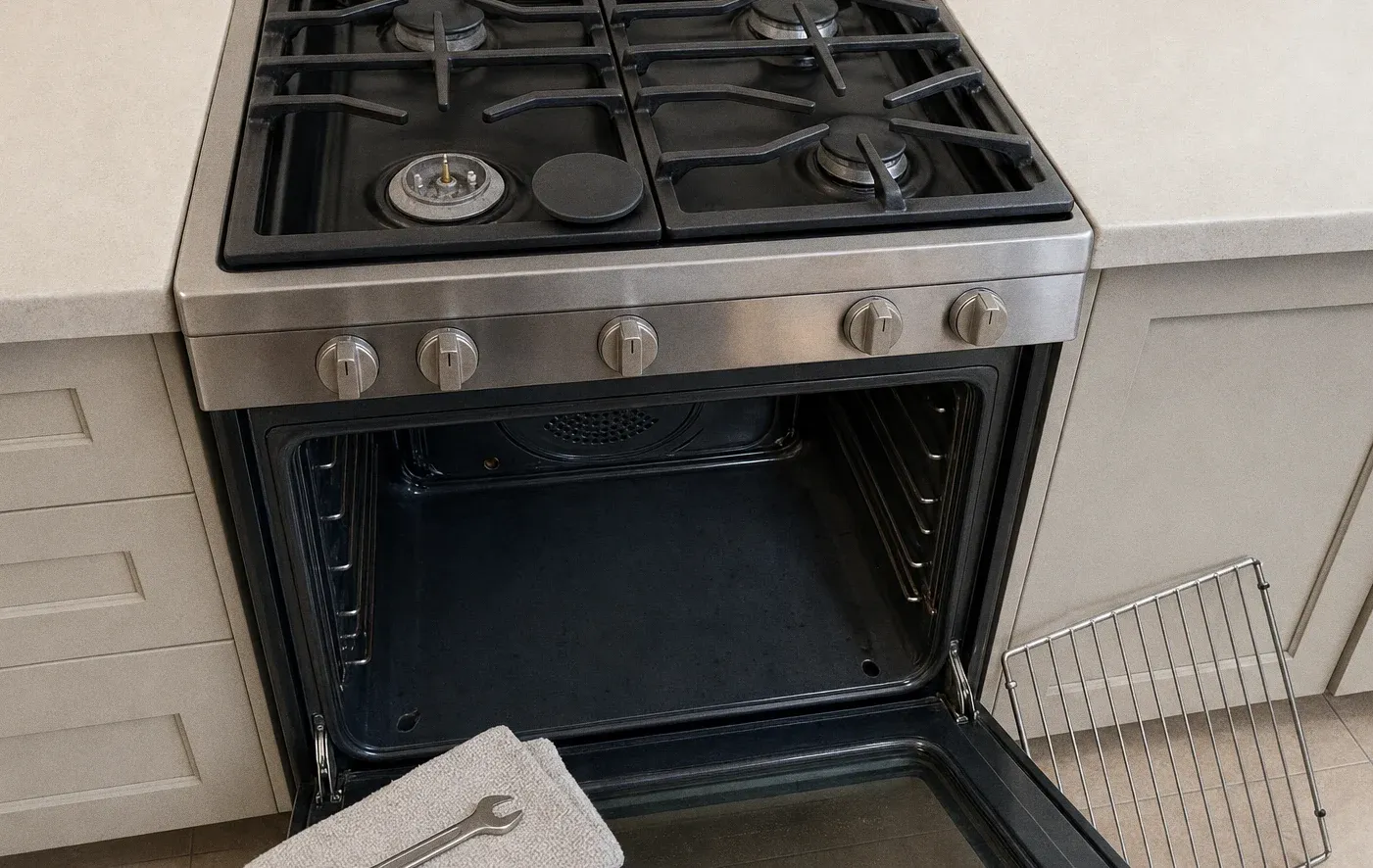
Roast on a Wolf oven is a still-air setting: the bake element under the floor and the broil element in the ceiling take turns heating the cavity to the temperature you choose, and the convection fan stays off. Heat from both directions gives steady cooking below and browning on top, so the mode suits large and tougher cuts that spend hours in the oven, often in a covered pot. For most roasts, set 325°F to 350°F, put the pan on a lower rack, and judge doneness by internal temperature rather than by the clock. Several things Roast does on purpose look like faults the first time you notice them, and the sections below walk through each one before anyone pays for a visit.
That matters in plenty of Boston homes. Kitchens in older rowhouses and triple-deckers are often small and open to the living space, so a hot roast that spatters onto the top element gets noticed fast, and normal smoke is easy to mistake for a failing oven.
What the Roast setting is actually doing
Once you press Start, the oven heats until its sensor reads the set temperature, then switches the elements off and on to stay close to it. The display shows the number you picked, but the air inside drifts a little above and below that figure the whole time. That swing is how every thermostat-controlled oven behaves, and it is why a dial thermometer on the rack can show different numbers at different moments.
Because the broil element is part of the cycle, the surface of the food facing the ceiling gets more radiant heat than the sides. With no fan, the air around the meat stays still and fairly moist, which helps a braise or a covered roast stay tender over a long cook. Exactly which modes your oven offers, and the temperature each one opens with, depends on the series: an M Series, an E Series and an older L Series oven do not share an identical menu, so keep the use and care guide for your model within reach.
Roast or Convection Roast: picking the right one
Convection Roast brings in the fan at the back of the cavity. Moving air pulls moisture off the surface faster, so skin crisps and fat renders more evenly, and food often finishes sooner than the recipe says. On an M Series oven, Convection Roast comes up preset at 325°F (165°C), the same opening figure as plain Convection, and you can raise or lower it from there.
A simple way to choose:
- Plain Roast for pot roast, brisket, short ribs, lamb shoulder and anything in a lidded Dutch oven.
- Convection Roast for chicken, turkey, a standing rib roast, pork loin and vegetables you want caramelised at the edges.
- Either one for a leg of lamb: Roast gives a softer crust, Convection Roast a firmer one.
If you move a familiar recipe from Roast to Convection Roast, start checking the internal temperature well before the stated time. Many cooks also drop the setting by about 25°F when switching to a fan mode, then fine-tune on the next attempt.
Temperatures, racks and timing that work
For long, gentle cooks, 325°F is the dependable number. For a medium-sized roast where you want some colour, 350°F is a good middle. Higher settings brown faster, but on plain Roast the top darkens before the sides because the broil element is doing part of the work, so drop the rack a level whenever you go above 375°F.
Rack height matters more than people expect. Place the pan so the top of the meat sits several inches below the ceiling element; a tall bird on the middle rack can scorch at the breast while the thighs are still underdone. Let the oven finish preheating before the pan goes in, and keep the door shut, because every opening dumps heat and adds time.
Use a probe or a reliable instant-read thermometer for doneness. If the built-in probe gives numbers that disagree with a separate thermometer, our guide on testing a Wolf oven temp probe shows how to tell a probe fault from a placement mistake.
One timing detail catches people out on an E Series oven. Its timers can count as long as 99 hours and 59 minutes, but they run separately from the oven, so a timer reaching zero beeps and nothing else changes. If you want the oven itself to stop, set cook time or stop time instead.
Roast behaviour that looks like a fault
The top is much darker than the sides
That is the broil element doing its share. Lower the rack, tent the top loosely with foil partway through, or switch to Convection Roast for more even colour.
The fan never starts
Plain Roast does not use the convection fan, so a still fan is correct. You may still hear a cooling blower near the controls; that is a separate part. A fan that stays still in Convection Roast is a different matter.
The oven switched off partway through a long cook
Left running for 12 hours straight, an E Series control ends the cook on its own; Dehydrate and Sabbath are the only two modes exempt from that cutoff. For an overnight braise, that shutdown is the oven following its own rules. Restart the mode if the meat needs longer.
A new temperature did not seem to take
Check whether Sabbath is on. On an M Series oven, Sabbath allows only Bake, Roast, Proof and Warm, it begins ten seconds after you press Start, and a temperature you change during Sabbath takes effect at a random moment rather than straight away. On an L Series oven, you start Sabbath by choosing Bake or Roast and a temperature, then holding ENTER for 5 seconds until SABBATH shows; touching OVEN OFF ends it.
The touchscreen will not respond
On an E Series oven, the Lock feature disables the control panel and touchscreen; hold Lock for three seconds to release it. After a power cut, the lock has to be set again if you rely on it.
Smoke and a hot smell
A little smoke is normal when fat spatters onto the top element. A new oven also smokes during its first heat: an M Series oven should be washed with hot water and mild detergent, then run on Convection Roast at 500°F (260°C) for an hour with the hood running. If smoke hangs in the room, read our note on where a Wolf hood’s airflow goes.
When a Roast problem really is a repair
Some symptoms are not habits of the mode. Call for a diagnosis if the oven never reaches the set temperature, if one element stays dark while the other glows, if roasts come out badly over- or underdone in every mode, if the convection fan stays still in Convection Roast, or if the display shows a fault message.
Before blaming the thermostat, put an oven thermometer in the centre of the middle rack, set Roast to 350°F, and read it after the oven has held temperature for 20 minutes. A small gap is normal swing; a large, consistent one is worth reporting. Wolf says temperature calibration can be done but is rarely needed, and treats it as a service task rather than a homeowner adjustment. Any offset shifts every cooking mode at once, so mention it if someone has adjusted the oven before. On an M Series oven, the Temp Offset item in the Settings menu is reserved for service, while the Calibration item beside it only aligns the touchscreen and does nothing to the heat.
Typical ranges, which turn into a firm quote after diagnosis: thermostat or sensor calibration runs $140–$660, a convection fan or motor $320–$850, and a control board or touch panel $540–$1,600. Having a technician come out and track down the fault costs $95, and once you give the go-ahead, that sum is deducted from the repair itself. Wolf Repair Boston covers Beacon Hill, Back Bay, Jamaica Plain and Washington Square. Call (617) 396-3696 or see our Wolf oven repair page.
Asked on the phone
What temperature should I use for Roast on a Wolf oven?
For most large cuts, 325°F to 350°F on Roast works well, with the lower figure for tougher meat that cooks for hours. Higher heat browns faster, but the top of the food sits closest to the broil element and darkens first, so lower the rack a level if you go above 375°F.
Does the convection fan run in Wolf Roast mode?
No, plain Roast is a still-air mode, so a fan that stays still is normal. You may hear a cooling blower near the controls, which is a separate part. The convection fan only turns in fan modes such as Convection Roast, and a fan that stays still there is worth a diagnosis.
Why did my Wolf oven shut off in the middle of a long roast?
Most likely the E Series 12-hour limit: after half a day of nonstop heating the control shuts the cook down, unless the oven is in Dehydrate or Sabbath. That is a built-in safety limit rather than a failure, so restart the mode if an overnight braise still needs more time.
Can I calibrate the Roast temperature myself?
Not in the way Wolf intends: it describes calibration as possible but rarely needed, and as a service task rather than a homeowner setting. An offset changes every cooking mode at once, not only Roast, so test first with an oven thermometer and tell the technician if the oven was adjusted before.
Should I use Roast or Convection Roast for a turkey?
Convection Roast is usually the better pick for a turkey or a chicken, because moving air crisps the skin and tends to finish sooner. Keep plain Roast for covered pot roasts, brisket and other tough cuts, where gentle, steady heat matters more than a crisp surface.